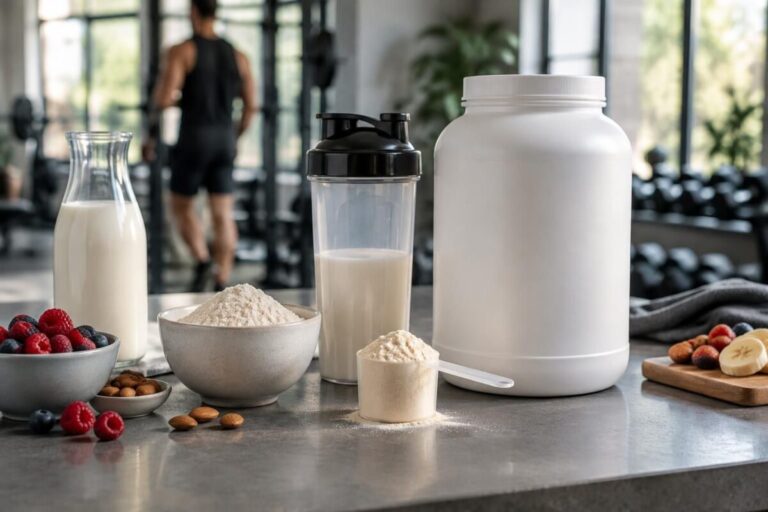
Sports nutrition: gaining muscle without fat—is it mission impossible?
Hi, this is Orvane. Gaining muscle without any fat gain isn’t possible, but a moderate calorie surplus can support muscle growth while limiting fat storage. With a well-balanced sports diet, progressive training and regular monitoring, muscle gain can be kept under control. The goal isn’t to turn every meal into a calculation, but to give your body enough energy to make progress.
Lean bulking: 5 things to remember
- Aim for a small calorie surplus, around 5 to 10% above your estimated needs, then adjust based on how your weight changes.
- Consume enough protein: a range of 1.6 to 2.2 g per kilogram of body weight per day works for many people who train.
- Progressively improve your strength training by gradually increasing the weight, repetitions or quality of your technique.
- Monitor your body composition using several indicators: average weight, waist measurement, performance and photos taken under the same conditions.
- Make room for sleep and recovery: they support your progress just as much as a well-designed program.
To avoid confusing speed with effectiveness, also learn about the risks of gaining weight too quickly and the basics of a strength training program for beginners looking to gain muscle. These guidelines can help you maintain a controlled calorie intake without sacrificing the quality of your workouts.
Why gaining muscle without any fat is unrealistic
Your body can’t direct every excess calorie exclusively toward muscle. Lean bulking refers instead to a phase in which muscle gain is prioritized and fat gain is carefully managed.
The results depend, among other things, on your experience, starting point, training and recovery. A beginner may sometimes gain muscle while reducing body fat, whereas a more experienced trainee often makes progress more slowly.
The calorie surplus: a fine-tuning adjustment, not a huge leap
A large surplus can make your weight rise quickly, but that increase doesn’t necessarily mean you’re gaining more muscle tissue. A modest surplus, adjusted over the course of several weeks, makes your progress easier to assess.
For example, if your average weight increases by more than 0.5% per week and your waist measurement rises quickly, your calorie intake may be too high. A target of around 0.25 to 0.5% of body weight per week is a general guideline to adapt to your profile and results.
Protein and macronutrients: structuring your sports diet
Protein provides the building blocks needed for muscle repair and growth. Spread it across several meals and choose a variety of sources: eggs, dairy products, fish, meat, tofu, legumes or suitable plant-based alternatives.
Carbohydrates fuel your workouts and help you maintain productive training sessions. Fats also contribute to a balanced diet: there’s no need to cut them out to manage fat gain.
| Guideline | Practical approach | Why track it |
|---|---|---|
| Protein | About 1.6 to 2.2 g/kg/day | Support recovery and muscle growth |
| Calorie surplus | Start at around 5 to 10% | Avoid an excessive increase in calorie intake |
| Weight changes | Track the weekly average | Reduce the effect of day-to-day fluctuations |
| Waist measurement | Measure under similar conditions | Complement body composition tracking |
These figures are guidelines, not rigid requirements. If you have a medical condition, specific needs or a complicated relationship with food, seek advice from a healthcare professional or registered dietitian.
Common mistake: increasing calories before checking the basics
When progress slows, it’s tempting to immediately add a large surplus. However, poor technique, inconsistent workouts or too little sleep can hinder muscle growth before diet is even a factor.
Imagine Lina, who adds a very high-calorie snack every day after two weeks with no change on the scale. Instead, by tracking her average weight, waist measurement and performance for three weeks, she realizes that her workouts mainly lacked consistency: calories weren’t necessarily the problem.
How to adjust your bulk without overdoing it
The scale alone doesn’t tell the whole story. A tough workout, a saltier meal or a change in carbohydrate stores can cause your weight to fluctuate from one day to the next.
Instead, compare weekly averages and look at trends over several weeks. If your strength is improving, your weight is increasing slowly and your waist measurement remains relatively stable, your approach is probably better calibrated than one involving a rapid increase in calories.
A 3-step process for controlled muscle gain
- Establish your starting point. Record your weight on several mornings each week, your measurements, your usual meals and your performance. Measure under the same conditions so you can compare useful data.
- Add a moderate surplus. Slightly increase your portions or add a nourishing snack, then stick with this approach for two to three weeks. Make sure your meals include protein, carbohydrates, fats and fiber-rich foods.
- Adjust based on trends. If your weight isn’t changing and your performance has stalled, increase your intake a little. If your weight and waist measurement are rising quickly, reduce it slightly rather than overhauling your whole plan.
The key isn’t to control every bite, but to build a routine that’s consistent enough to help you figure out what works. Slow, measurable progress is better than a dramatic weight gain that’s difficult to correct.
Frequently asked questions about gaining muscle without fat
Can you gain muscle without gaining fat?
Gaining muscle with zero fat gain isn’t guaranteed. However, a moderate calorie surplus, progressive training and regular monitoring can help limit fat gain.
How much protein should you consume to gain muscle?
A range of about 1.6 to 2.2 g of protein per kilogram of body weight per day is a common guideline for people who train. Individual needs may vary.
Do you need to eat a lot more to build muscle?
No. A large surplus doesn’t necessarily accelerate muscle growth and may increase fat storage. Start with a modest surplus and adjust based on the results you observe.
How can I tell if my bulk is well controlled?
Track your average weight, waist measurement and performance over several weeks. Slow progress accompanied by improvements in training is more informative than a single weigh-in.
I hope you found these tips helpful. See you soon! — Orvane